Packaging EPR Exposure Doesn't Stay With the Seller
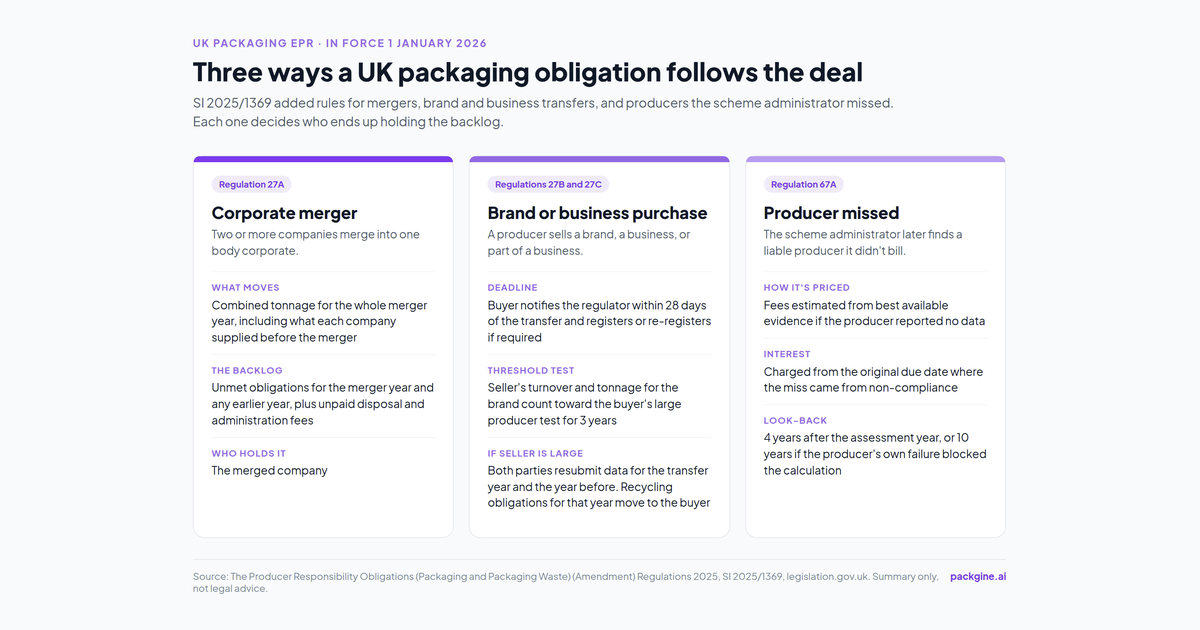
A common assumption on consumer deals is that packaging EPR exposure stays with the seller. Whatever the target failed to register or report is their mess and their bill.
For UK deals, the law now says otherwise. Amendments in force since 1 January 2026 spell out what happens to a producer's obligations in a merger or a brand sale, and much of the backlog can travel with the deal.
In the US, how liability moves turns on deal structure and state law, which is a question for your counsel. The diligence work itself looks the same in both markets.
In this article: what UK law now hands to the buyer · the one data room request that tells you almost everything · the four diligence checks · three worked cases · pricing the exposure · the first 90 days after close · short answers for deal teams
What UK law now hands to the buyer
The Producer Responsibility Obligations (Packaging and Packaging Waste) (Amendment) Regulations 2025 (SI 2025/1369) added rules on mergers, brand transfers and late assessment to the 2024 packaging EPR regulations (SI 2024/1332). If you're new to how UK fees are built, start with our explainer on the UK pEPR base fee formula.
Mergers: regulation 27A
If either merging company was a large or small producer that year, the merged company is treated as supplying the combined tonnage for the whole year, including what each business supplied before the merger, under regulation 27A(4). On the backlog, the regulation doesn't hedge:
"CB must comply with the producer responsibility obligations of each of the merged bodies"
That covers the merger year and any earlier year, for any obligation not fully met, plus disposal and administration fees left unpaid, under regulations 27A(5) to (9). It also covers continuing obligations, such as keeping data and evidence.
Brand and business purchases: regulation 27B
The buyer has 28 days from the transfer to tell the regulator what it bought, from whom and when, and must register or re-register where required, under regulation 27B(2) and (3). For that year and the next two, the seller's turnover and tonnage attributable to the acquired brand are added to the buyer's own when testing large producer status, which regulation 27B(4) sets at more than £2 million turnover and more than 50 tonnes of packaging. Our guide to small producer thresholds across the UK, EU and US shows how easily a bolt-on can push a buyer over the line.
When the seller is a large producer: regulation 27C
Regulation 27C requires both parties to submit or resubmit data for the transfer year and the year before, with the brand's pre-transfer packaging treated as supplied by the buyer. Recycling obligations for that packaging in the transfer year move to the buyer. The seller must resubmit even if it is no longer a producer.
Producers the scheme missed: regulation 67A
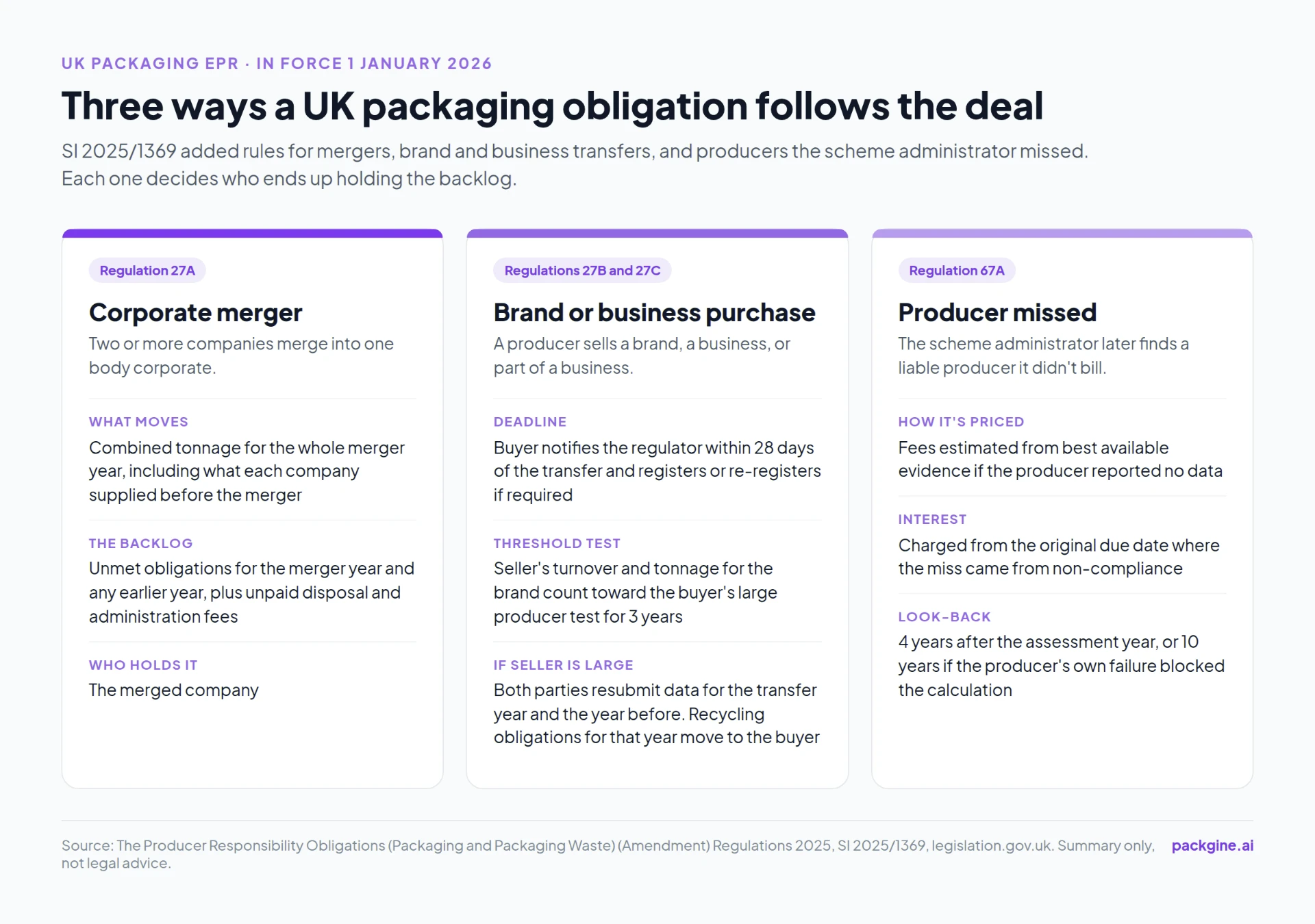
Regulation 67A adds a late assessment route. If the scheme administrator later identifies a liable producer it missed, it can estimate fees from the best available evidence where that producer reported no data. Where the miss came from non-compliance, it can charge interest from the date the fees would have fallen due. It has 4 years after the assessment year to serve notice, or 10 years if the producer's own failure prevented the calculation.
Producers must also keep packaging data and evidence for at least 7 years after each reporting period, under regulation 34(2) as amended. A target that can't produce records that far back has handed you a finding.
Takeaway: in a UK merger, the backlog is the merged company's backlog. In a UK brand deal, the clock starts on the transfer date.
The one data room request that tells you almost everything
Send this in week one:
Provide packaging EPR registrations by program, and packaging placed on the market by material, weight and jurisdiction for the last three reporting periods.
Suppose the reply says packaging data sits with suppliers and co-manufacturers and no consolidated record is kept. That is not a gap to note and move past. It's the finding, and pricing it is what this workstream is for.
It's also more common than deal teams expect. Our piece on co-packer EPR responsibility explains why the brand, not the co-packer, usually carries the reporting obligation even when the co-packer holds the data.
What packaging compliance due diligence checks
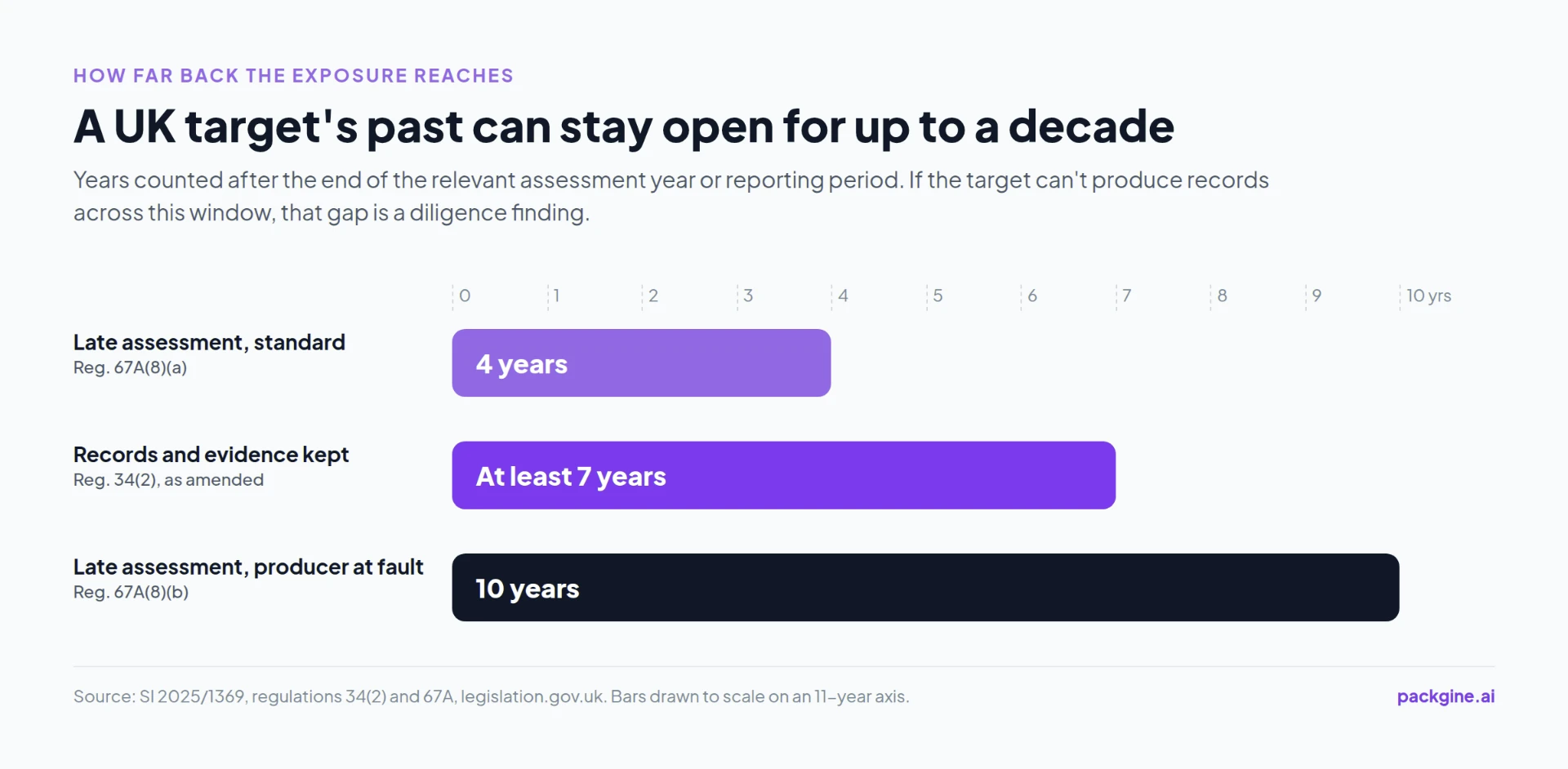
Packaging compliance due diligence tests whether a target has met its packaging EPR obligations everywhere it sells, whether its filings rest on records it can produce, and what past and future fees a buyer would inherit. The output is a priced exposure range with stated confidence.
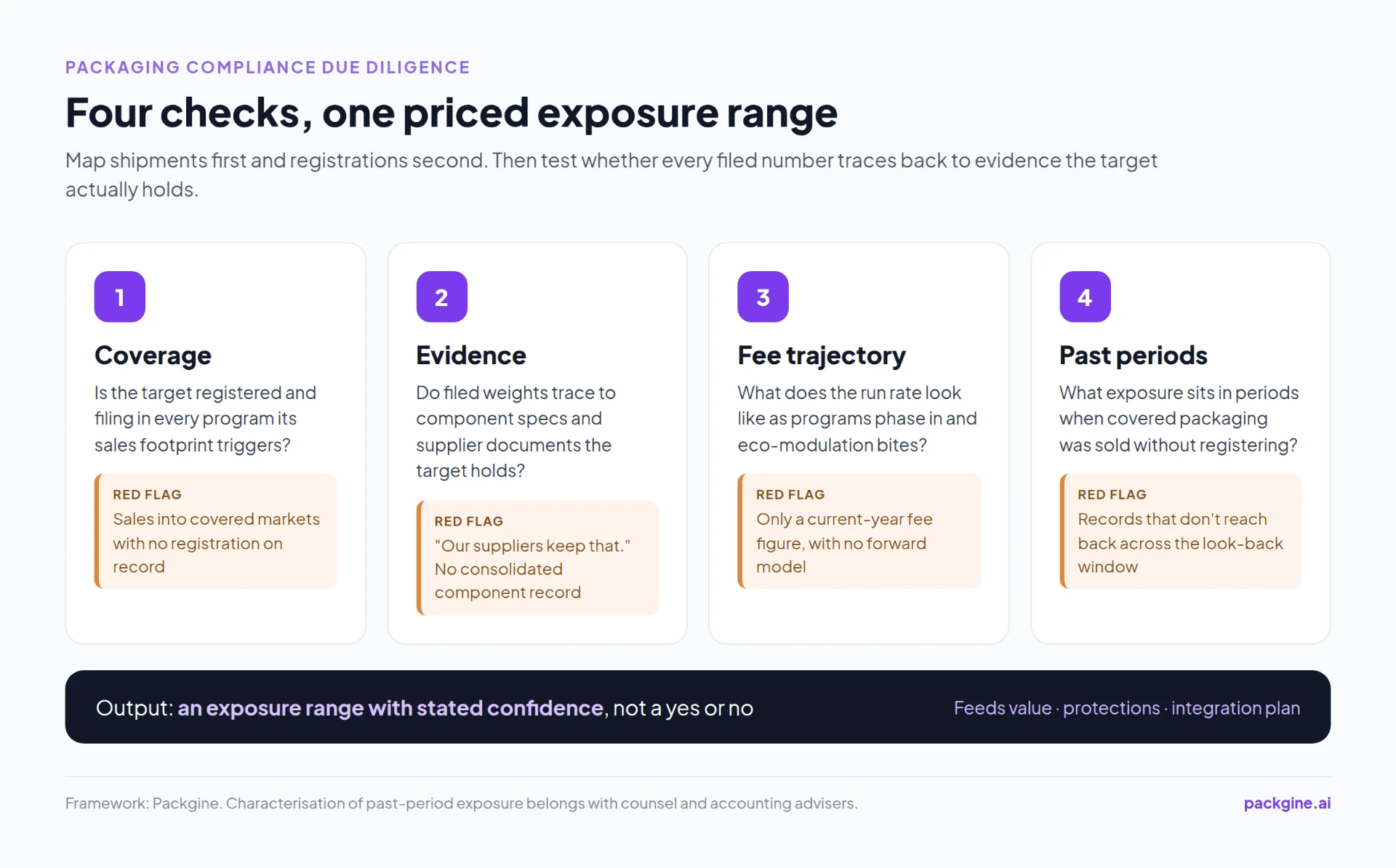
It comes down to four checks:
- Coverage. Is the target registered and filing in every program its footprint triggers? Map shipments first, registrations second. Our producer registration checklist lists what each program asks for.
- Evidence. Do the filed numbers trace to component specs and supplier documents the target holds?
- Fee trajectory. What will the run rate look like as programs phase in?
- Past periods. What exposure sits in periods when the target sold covered packaging without registering?
Turn the gaps into a screen like this:
| Finding | What it could mean | Confidence | Next request |
|---|---|---|---|
| Sales into two covered markets, no registration found | Past-period exposure that keeps accruing until signing | High | Registration searches; characterisation by counsel |
| No consolidated product and component record | Filings rest on estimates; rebuild needed after close | High | Supplier files for the top ten products by volume |
| Recycled content claim on pack, evidence only in supplier files | Claim risk, and evidence the buyer won't acquire | Medium | Certificates for the specific grade and site |
| No forward fee model | Current-year cost understates the inherited run rate | High | Volumes by market, trailing twelve months |
| Packaging changes with no dated record | Filed weights may not match what shipped | Medium | Change log and effective dates for the top ten products |
A certificate sitting in a supplier's inbox isn't the target's evidence, and it won't transfer on completion unless someone asks for it. Our piece on supplier documentation as evidence covers what a certificate needs to carry. For the last row, Two Grams Nobody Reported shows how a 2 g lightweighting left invoices and the compliance record about 220 kg apart per million bottles.
Why standard diligence walks past it
Environmental diligence looks for contamination, permits and litigation. Packaging EPR is administrative obligations accruing quietly in every unregistered period, and none of it shows up on a site visit.
Registration status is the other trap. A registered target can still be repriceable if its filings rest on estimated weights or evidence it doesn't hold. Our breakdown of EPR penalties and enforcement covers what typically triggers audits. A registration list answers the coverage question and leaves the evidence question open.
A useful test: could the target answer a regulator's evidence request in a day? Our guide to audit readiness in 24 hours describes what that looks like. If the answer is "we'd need a few weeks to pull it together," you've learned something about the filings.
Three deals, three ways it lands
The cases below are illustrative composites built from common deal patterns. Names and numbers are invented to show the method, not drawn from any single transaction.
Case 1: The merger that inherited two years of silence
The deal. A UK personal care group (registered, large producer) merges with a fast-growing haircare company. Both companies fold into one new body corporate in September 2026.
What diligence found. The haircare company crossed the large producer thresholds two years earlier but never registered. Its packaging data sat with three contract fillers. Nobody had added it up.
What the law does. Under regulation 27A, the merged company is treated as supplying both businesses' tonnage for all of 2026, and it picks up the haircare company's unmet obligations and unpaid fees for earlier years. Under regulation 67A, the scheme administrator can estimate those fees from best available evidence and charge interest from the original due dates, because the miss came from non-compliance.
How the team priced it. They rebuilt tonnage from shipped units multiplied by component weights, by material, for every year in scope, then applied the published base fee for each material category. They labelled every weight that came from a filler's estimate rather than a spec sheet. The range went into the model, and a specific indemnity went into the merger agreement.
The lesson. In a merger there's no "seller" left to chase. The backlog belongs to the company you just created.
Case 2: The brand carve-out that tipped the buyer into large producer status
The deal. A mid-sized buyer acquires a skincare brand from a large producer. The transfer completes on 15 May 2026.
The numbers that mattered (illustrative):
| Turnover | Packaging supplied | |
|---|---|---|
| Buyer on its own | £1.6m | 30 t |
| Acquired brand's share of seller | £1.1m | 35 t |
| Adjusted total for the large producer test | £2.7m | 65 t |
On its own, the buyer was a small producer. With the brand's share added, as regulation 27B(4) and (5) require, it clears both the £2 million and 50 tonne tests and is treated as a large producer for 2026, 2027 and 2028.
What had to happen, and when.
- By 12 June 2026: the buyer notifies the regulator of the brand, the seller and the transfer date, and re-registers as a large producer (regulation 27B).
- Both parties resubmit data for the 2025 and 2026 reporting periods, with the brand's pre-transfer packaging moved to the buyer's numbers (regulation 27C).
- The 2026 recycling obligations for the brand's packaging move from the seller to the buyer.
What nearly went wrong. The seller's packaging team was being wound down after the sale. The buyer's filings depended on the seller's resubmission. The buyer's counsel added a cooperation covenant with a named deadline and a named contact. Without it, the buyer would have been chasing a team that no longer existed.
The lesson. On a brand deal, the 28-day clock and the seller's cooperation both belong in the purchase agreement and on the completion checklist.
Case 3: The US roll-up with no registrations
The deal. A private equity platform buys a direct-to-consumer supplement brand. The brand ships to customers nationwide, including Oregon and California, and has no EPR registrations anywhere. If that sounds familiar, our case studies page describes a DTC supplement brand that found itself covered under both SB 54 and Oregon's law without realising it.
Rebuilding the tonnage (illustrative):
- Packaging per unit: PET jar 60 g, PP lid 12 g, paperboard carton 20 g, so 92 g.
- Oregon: about 210,000 units a year, so roughly 19 t of covered packaging a year.
- California: about 1.5 million units a year, so roughly 138 t a year.
Pricing in tiers. Oregon is already billing: obligated producers began paying fees to Circular Action Alliance when the program launched on 1 July 2025, according to Oregon DEQ. That makes the Oregon past-period number a high-confidence figure. California's fee schedule isn't final, so it gets a band. States without published rates get a structural range.
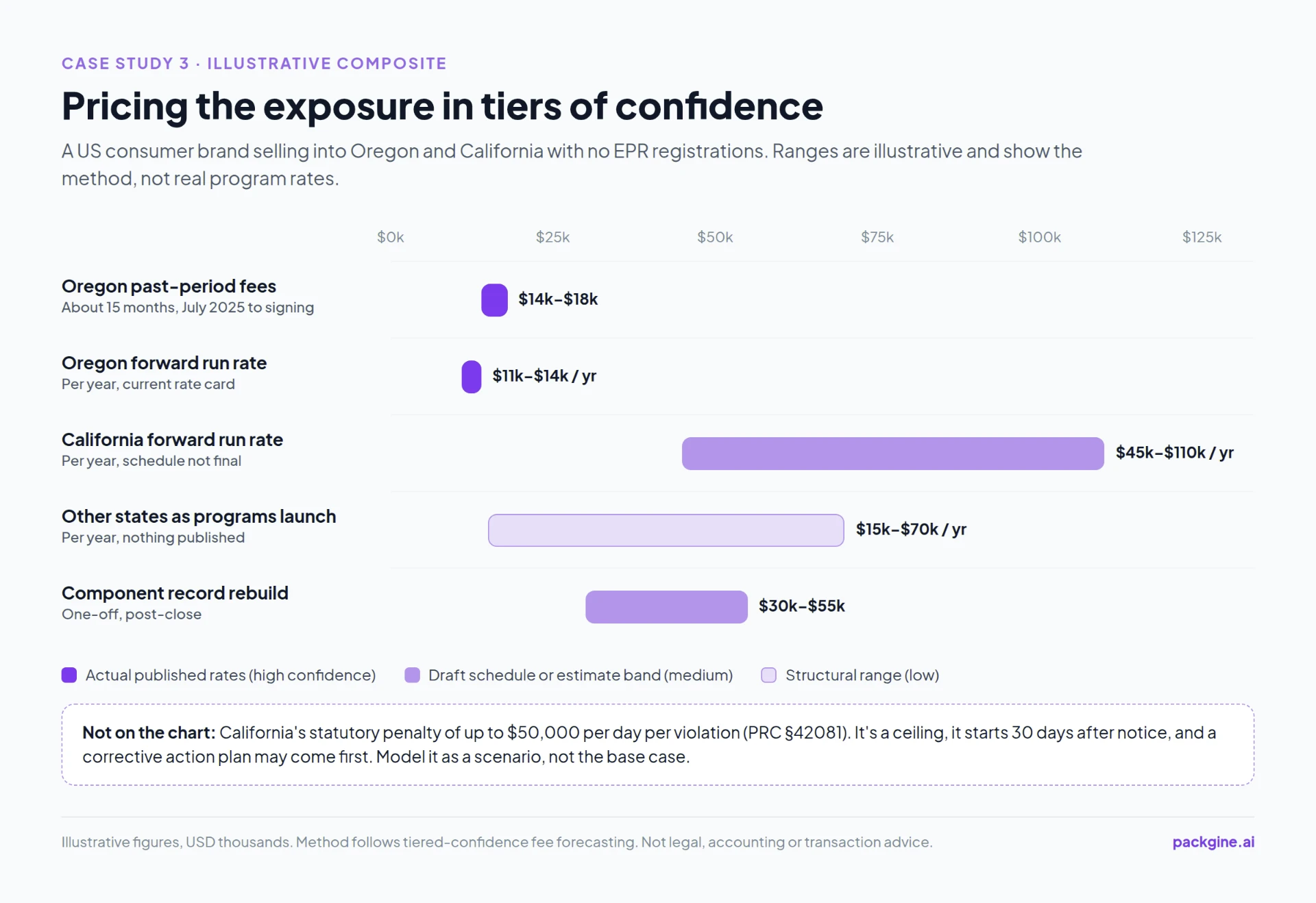
The lesson. The scary number in California is the penalty ceiling. The number that actually lands is unpaid fees plus the cost of rebuilding the record.
Putting a number on it
Where flags fire, reconstruct tonnage by material and jurisdiction from what exists, usually sales volumes by market multiplied by component weights. Label every estimate as an estimate.
Then price it with tiered confidence. Where a program is already billing producers, use actual rates, as Oregon producers have been paying since 1 July 2025. Where a schedule is still draft, use a band. Where nothing is published, use a structural range. Our guide to EPR fee forecasting walks through the method, and multi-state EPR cost modeling shows how to roll it up across a footprint.
Setting the record straight on "$50,000 a day"
Under Public Resources Code section 42081, added by SB 54, CalRecycle may impose an administrative civil penalty of up to $50,000 per day per violation, or $25,000 for entities meeting the criteria in section 42060(a)(5). Penalties don't begin accruing until 30 calendar days after notice, and CalRecycle may allow a corrective action plan, of up to 24 months, before deciding whether to assess one, per section 42081(b).
Treat the figure as a ceiling. Model the unpaid fees and the record rebuild as the working number. For where California's program stands today, see our SB 54 guide.
Characterising past-period exposure, including penalties, interest and accounting treatment, belongs with counsel and accounting advisers. Nothing here is legal, accounting or transaction advice.
Three questions the deal team owns
Every finding goes through three questions, owned by the deal team and counsel:
| Question | What it looks like in practice |
|---|---|
| Does it change value? | A run rate the model has to carry |
| Does it change protections? | Representations, indemnities, or a specific escrow sized against the past-period range |
| Does it change the integration plan? | A priced remediation line with an owner |
Surface these before signing. After completion, the same facts are simply the buyer's costs.
One drafting point for UK brand deals where the seller is a large producer. Regulation 27C requires the seller to resubmit its data even after it stops being a producer, and your filings depend on that resubmission. Put a cooperation covenant with a named deadline in the purchase agreement.
The first 90 days after completion
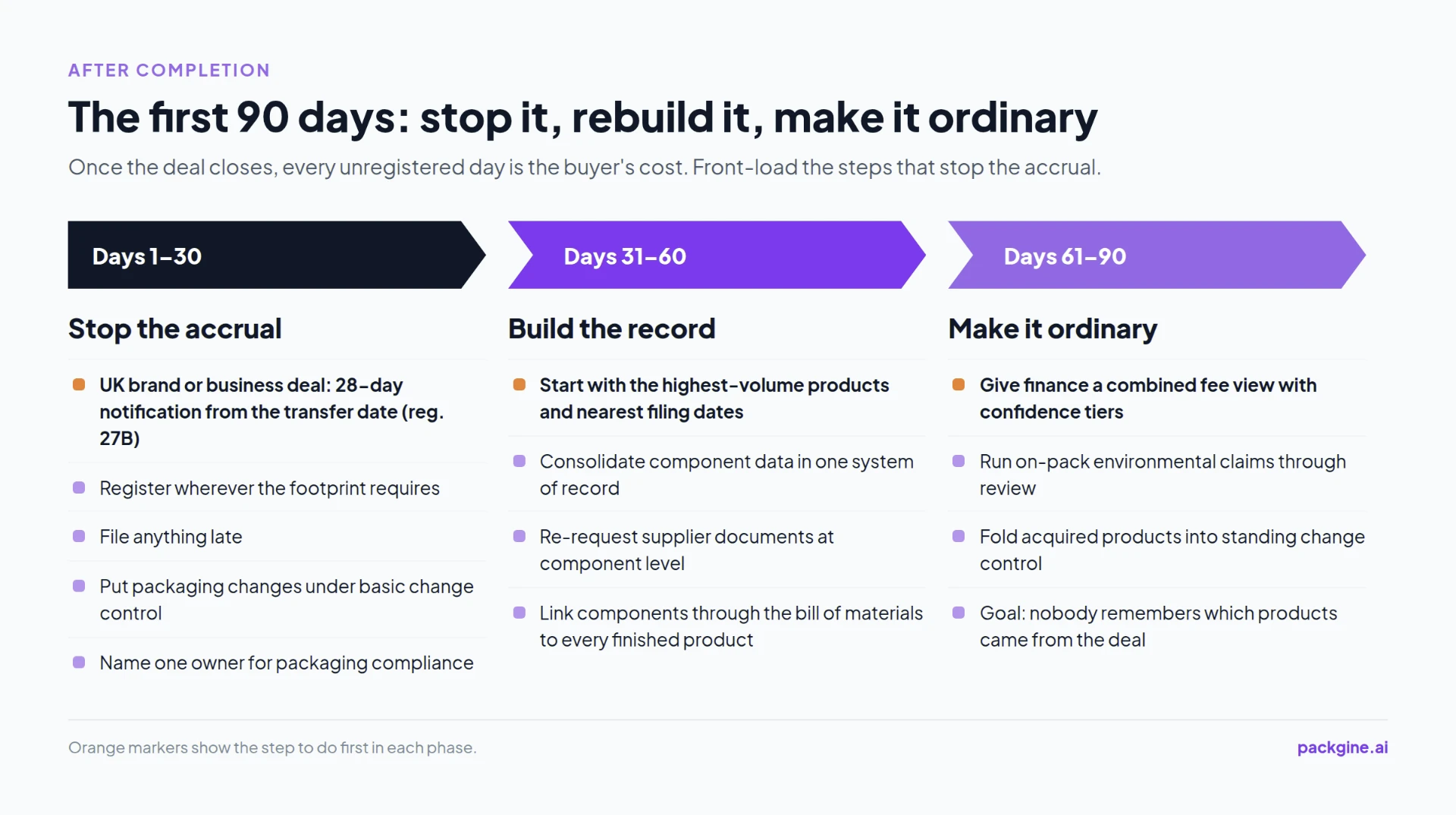
Days 1 to 30: stop the accrual
Register wherever the footprint requires and file anything late. On a UK brand or business acquisition, the 28-day notification under regulation 27B runs from the transfer date, so it belongs on the completion checklist. Freeze packaging changes into basic change control, and name one person who owns packaging compliance across the combined business.
Days 31 to 60: build the record
Consolidate component data, starting with the highest-volume products and the nearest filing dates, and re-request supplier documents at component level. Packgine's Packaging Specification Hub holds that rebuild. Component specs link through the bill of materials to every finished product that uses them, each record keeps its history, and suppliers upload certificates against the spec they support.
Days 61 to 90: make it ordinary
Give finance a fee view on the combined footprint with confidence tiers. Run on-pack environmental claims through a claims review, and fold the acquired products into standing change control. Our compliance launch gates give you the checks to run before any acquired product's next artwork change.
The goal is a portfolio where nobody remembers which products came from the deal.
Short answers for deal teams
Does a buyer inherit unpaid packaging EPR fees in the UK?
In a corporate merger, yes. Regulation 27A makes the merged company liable for the merged bodies' unpaid fees and unmet obligations. Where a large producer transfers a brand, regulation 27C has both parties resubmit data, and fees for the assessment year starting that April are calculated on the resubmitted data (SI 2025/1369).
How far back can UK regulators assess a producer they missed?
Up to 4 years after the assessment year, or up to 10 years where the producer's own non-compliance prevented the calculation, under regulation 67A.
When does a UK brand buyer have to notify the regulator?
Within 28 days after the date of the transfer of ownership, under regulation 27B(2).
How should a deal model treat California's $50,000 a day penalty?
As a statutory ceiling under Public Resources Code section 42081. Penalties start accruing 30 days after notice, and CalRecycle may allow a corrective action plan first.
Is a registered target a clean target?
Not necessarily. Registration answers the coverage question. Whether the filed weights trace to records the target holds is a separate check.
Before your next LOI goes out
Add the week-one packaging request to your standard data room list, and put the UK 28-day notification on every completion checklist that touches a UK brand. Both cost nothing. Leaving them off is how a range you could have priced before signing arrives as an invoice after close.
Working a deal now? Talk to the Packgine team with whatever packaging data the seller has shared, or run the target's footprint through the EPR checker first.
Sources
- The Producer Responsibility Obligations (Packaging and Packaging Waste) (Amendment) Regulations 2025, SI 2025/1369, regulations 27A, 27B, 27C, 34(2) and 67A; Schedule 1, corporate mergers and acquisitions
- The Producer Responsibility Obligations (Packaging and Packaging Waste) Regulations 2024, SI 2024/1332
- California SB 54 (2022), Plastic Pollution Prevention and Packaging Producer Responsibility Act
- California Public Resources Code section 42081
- Oregon DEQ, "Oregon leads nation with Recycling Modernization Act implementation"
Related reading on Packgine
- Packaging Supplier Documentation: What Certificates Prove
- EPR Penalties and Enforcement: Audits and Fines
- EPR Fee Forecasting: Build a Number Finance Can Defend
- Co-Packer EPR Responsibility: Who Owns the Packaging Data?
- Packaging Change Control for EPR: Two Grams Nobody Reported
- EPR and PPWR Audit Readiness in 24 Hours
- Small Producer EPR Thresholds: UK, EU and US
Ajay Vasanthakumar
Marketing Director at gCurv Technologies