The Co-Packer Doesn't File Your EPR Report. In Most Cases, You Do.

Ajay Vasanthakumar, Marketing Director at gCurv Technologies
Published: September 14, 2026 | Updated: September 14, 2026
Four companies touch a product your co-packer runs. In California and under PPWR, the obligation usually lands on the brand, which holds the least data. In the UK, some of it can land on the co-packer. Either way, the fix belongs in the contract.
"Our co-packer handles the packaging side."
I hear that line, or something close to it, on a lot of calls with brands that outsource production. It tends to come right after I ask who supplies the component weights for their EPR report. And I get why people believe it. The co-packer buys half the materials and runs the line, so it feels like the paperwork should live there too. It doesn't.
Start with the obligation, because everything else hangs off it. In packaging extended producer responsibility (EPR), the brand on the pack usually decides who carries the obligation, though every program draws the line its own way. Under California's SB 54, the producer is first the company that makes the product and owns the brand or holds an exclusive license to it, as long as that company is in California. If no such company is in the state, the obligation moves to the brand owner if it's in the state, or failing that its exclusive licensee there, and after that to whoever sells or distributes the product into California. A co-packer that neither owns nor licenses your brand doesn't qualify under either of the first two tests.
The EU lands in the same place by a different route. Under the EU Packaging and Packaging Waste Regulation, which has applied since 12 August 2026, the company that has packaging designed or manufactured under its own name or trademark is the manufacturer. So you sign the conformity paperwork even when a co-packer fills the pack, a point we covered in PPWR Makes the Brand Owner the Manufacturer. For most brands selling into California or the EU, the buck stops with you.
What surprises people is the next part. The obligation sits with you, but most of the data sits with other companies, and the piece I find missing most often isn't anything the brand designed. It's the corrugated case and the pallet stretch wrap the co-packer buys on its own account, from its own suppliers. Plenty of brands have never seen a spec for either one. Some don't know those purchases happen. (The UK treats those two items differently, and I'll come to that.)
Nineteen emails, and nobody answered the question
One thread sticks with me. A brand asked its co-packer for the case specification. The co-packer said the converter would have it. The converter, which makes the film, replied that it ships what the brand approved and only keeps specs for its own material. Nobody had copied the distributor, even though its order system held the only record of which states the product actually went to. Nineteen messages went back and forth before anyone noticed that nobody was answering.
That was one product. Four companies had touched it, and not one of them held a complete record.
I don't blame any of them. The converter keeps specs for the film it sells. The co-packer keeps records for what it buys, and the distributor knows where every pallet went because that's how it invoices. The compliance record is the odd one out. The company that has to file it is the only one in the chain that never naturally holds what goes into it.
I'm not the only one seeing this. In a February 2026 client alert on packaging EPR, the regulatory law firm Amin Wasserman Gurnani told clients that most companies lack a system to capture the type and amount of packaging data EPR requires, and pointed them at bills of materials, purchase orders and supplier spec sheets as the places that data currently hides. That list is telling. Two of those three live outside your company.
Who holds which part of the record?
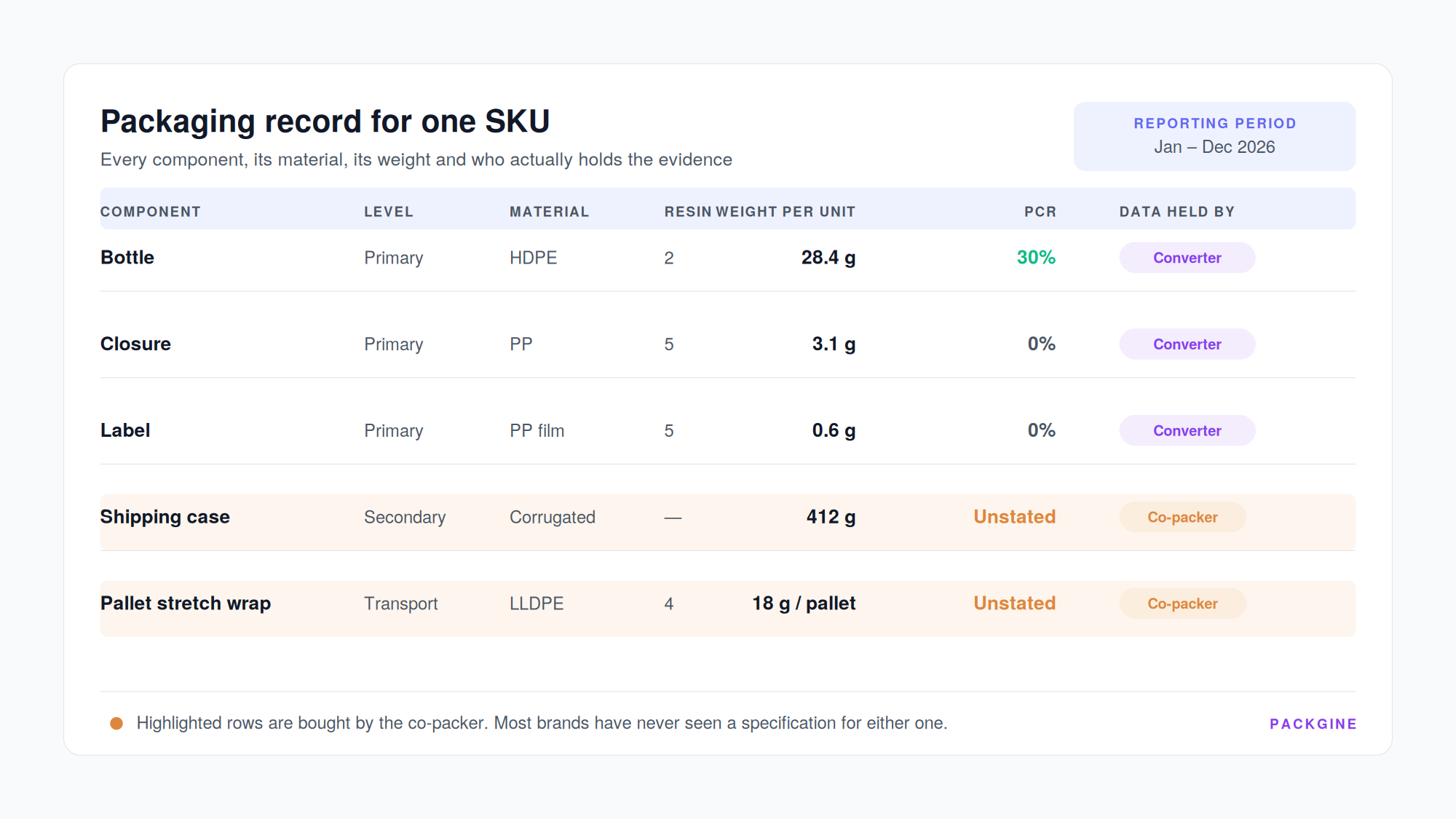
Follow one best seller through the chain and the split becomes obvious. The converter designed the film, so it holds the structure, the weights, the materials and any recycled content evidence for resin it bought. The co-packer holds the specs for the case and the wrap. The distributor holds shipments by state. You hold the trademark, the purchase orders and, in most programs, the obligation.
So what does an EPR filing actually need from all of that? Component specifications for everything from the bottle to the pallet wrap. Material and recycled content evidence, held at component level. Volumes placed on the market by product, jurisdiction and reporting period. Registration details, meaning which legal entity is registered in which program. Then the assembled report itself: tonnage by material by jurisdiction, with evidence attached wherever a fee discount or a claim depends on it. If you want the field by field version, our packaging data model post lists them.
A responsibility matrix for co-packing
| Data | Accountable | Who supplies it | What to watch |
|---|---|---|---|
| Primary component specs | Brand | Converter supplies them; co-packer confirms what actually runs on the line | Ask for component level fields. A datasheet PDF is not a spec |
| Secondary and transport specs | Brand in California. UK and PPWR: can sit with the co-packer or the packaging maker if unbranded | Co-packer, for anything it buys | The gap I see most. Brands often don't know these components exist |
| Recycled content and material evidence | Brand | Whoever bought the material | Certificates should carry your component reference, so they attach to the right record |
| Volumes by jurisdiction | Brand | Distributor, or your own order system | The allocation method has to match what each program asks for. See channel and country attribution |
| Registration and reporting | Brand for US state programs. PPWR fees: the producer in each member state, often your importer or distributor | Co-packer and converter answer data requests on agreed timing | You can hand off the inputs. You can't hand off accountability |
The supplying party follows the purchase order. Accountability sits with the brand except where the Accountable column says otherwise; see the next section.
Two rules sit underneath that table. For California and for PPWR conformity, accountability stays in one place, with the brand, because splitting it is exactly how the nineteen message thread happened. And the duty to supply data follows the purchase order. Whoever bought the material owes you its spec and its evidence. That second rule is the one that drags the co-packer's own purchases into the light, where before everyone quietly assumed somebody else had them covered.
Where the rule bends: transport packaging, the UK and EU fees
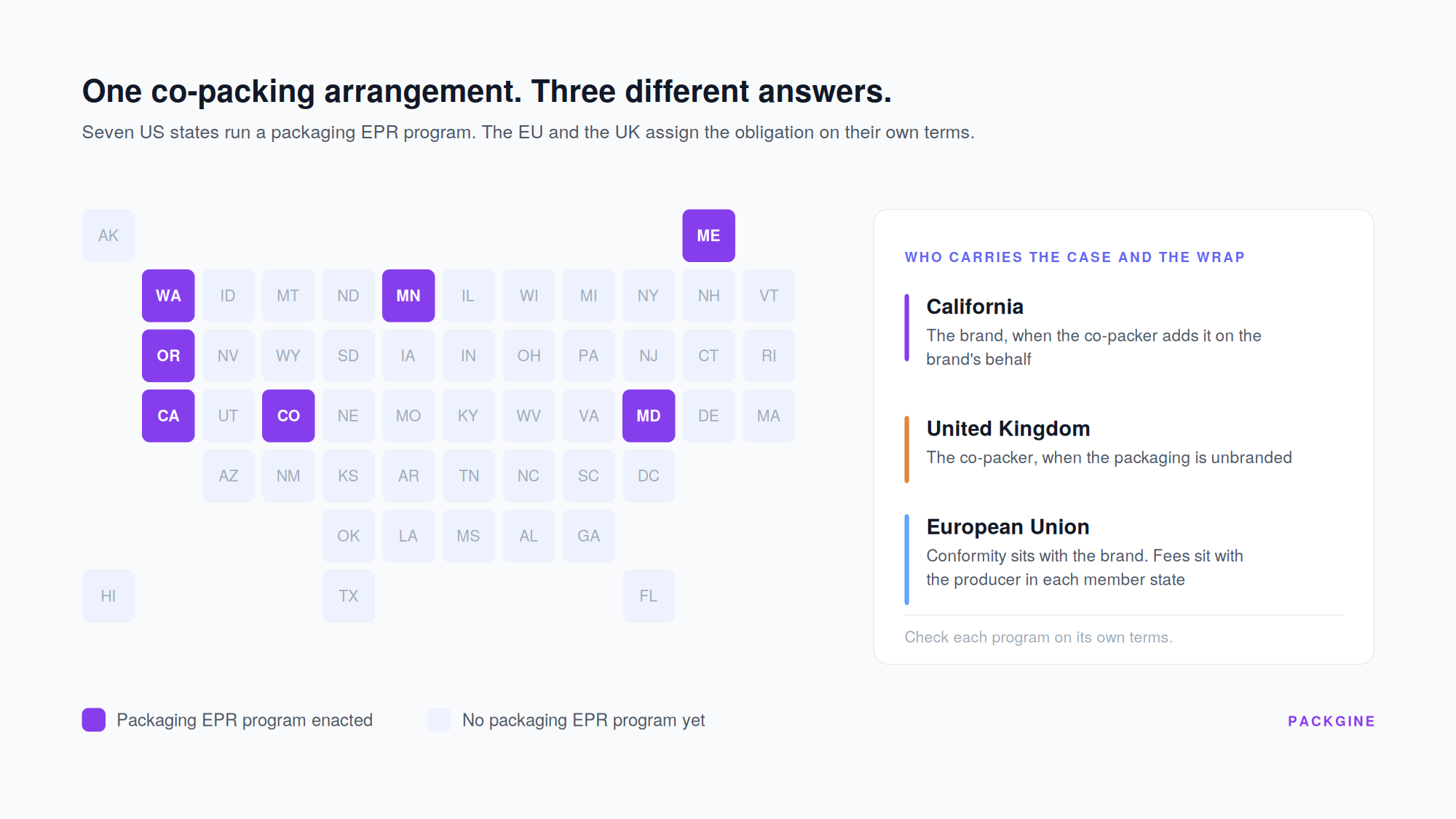
The case and the wrap are where programs disagree most, so check each one before you assume anything.
California is the friendliest to the matrix above. CalRecycle's regulations treat an in-state brand owner as the producer of transport and tertiary packaging used by the product before the next seller receives it, provided that packaging went on at the brand's direction or on its behalf. A co-packer running your line fits that description, so in California the case and the wrap are yours to report.
The UK flips it. Under the UK packaging EPR regulations, a brand owner is the producer for packaging that carries its brand, plus anything inside that packaging or forming part of it. A packer/filler, which is exactly what your co-packer is, becomes the producer for packaging it fills when that packaging carries no brand, or when the brand owner isn't a large producer. Each layer gets assessed on its own. A plain shipping case your co-packer puts around your branded bottles can therefore sit on the co-packer's report instead of yours.
PPWR splits the question in two. On conformity, the Commission's guidance says the manufacturer of transport packaging is normally the company that makes it, unless the user clearly brands it with its own name or trademark. On fees, the manufacturer and the EPR producer aren't always the same company. The producer registers and pays in each member state where the packaging is expected to become waste, and that's often your importer or distributor there. Our piece on B2B and industrial transport packaging covers more of these scope lines.
None of that changes the practical point. You can't make a scope call on a component nobody told you about, whichever program ends up owning it.
When should each party hand over data?
Work backward from each program's reporting deadline and fix the dates in advance. A matrix with no dates on it is a nice intention and very little else. I'd set three standing handoffs.
The first happens at onboarding or renewal. Every party transfers full component level specs for whatever it buys, plus the evidence behind any claimed attribute, and signs up to a duty to tell you about changes. For a California converter agreement, I'd write in weight per unit by resin type, recycled content backed by certificates, an attestation that the material is free of PFAS, and an update schedule tied to the SB 54 reporting calendar.
The second runs every reporting period. Whoever owns the order data sends volumes by jurisdiction, and the co-packer confirms that what actually ran on the line matches the specs on file. Give yourself enough lead time to reconcile those numbers. Receiving them the week of the filing isn't the same thing.
The third is triggered by change. When the co-packer switches case suppliers, that's a spec change, and it has to enter your change control with an effective date. Otherwise a switch halfway through the year quietly corrupts the whole year's tonnage. The two grams nobody reported is what that looks like when it goes wrong.
How long does this take to set up?
About a month for the first product, in the case I described. The converter reissued its recycled content certificate against the brand's own component reference. The co-packer disclosed the case and stretch wrap it buys itself, which put two components on the brand's list that had never appeared in its tonnage review. The distributor agreed to send a state level extract twenty days before each filing date.
The next forty products took a fortnight. Nobody had to rediscover who held what, because the matrix and the contract wording already existed. That ratio is the real argument for doing this properly once. A month sounds like a lot until you set it against rebuilding the same record by email every reporting season.
Where the shared record lives
A matrix only works if every party writes to the same record. Email attachments don't qualify. Neither does a shared drive folder called "EPR 2026".
In Packgine's Packaging Specification Hub, you share the component record with your converter and your co-packer, and they submit specs, resin certificates and COA documents against it through supplier sync. The bill of materials links primary, secondary, tertiary and transport components, so the co-packer's case sits in the same hierarchy as your bottle and traces up to every finished good it ships with. Every change is versioned, timestamped and attributed. When the co-packer changes case suppliers, you see a dated version with a name against it well before next year's reconciliation.
The volume side has its own tool. Inventory Compliance Alerts tracks tonnage by material and jurisdiction through an API connection to your ERP or WMS, and flags each active program at 60, 30 and 7 days before its deadline. That gives the distributor handoff a date on a calendar, which beats relying on somebody's memory.
To be clear about scope, Packgine doesn't decide who your producer is in each program, and it won't negotiate your co-packing agreement. It holds the record the agreement feeds.
The clause I'd put in every co-packing agreement
If I had to boil all of this down into one clause, it would read something like this:
Each party will supply component level specifications and supporting evidence for every packaging item it procures, notify the brand before any change to material, supplier or specification takes effect in production, and answer reporting period data requests within an agreed number of business days. The brand owns the assembled compliance record and the filings built on it.
Hand that to your counsel as a starting draft. Producer status differs by program, the UK's packer/filler rules can put some packaging on the co-packer's side of the line, and licensing deals, imports and marketplace channels can all move the obligation somewhere you didn't expect. The matrix sits on top of a proper legal answer for each program. It doesn't replace one.
Questions brands ask about co-packers and EPR
Can a co-packer ever be the producer?
Yes. In the UK it happens routinely: a co-packer is the producer for unbranded packaging it fills, and for packaging where the brand owner isn't a large producer. Under SB 54 the test is presence in California, not registration, and a manufacturer holding an exclusive license to your brand in the state can be the producer. Under PPWR, when the brand owner is a micro-enterprise (fewer than 10 employees, and turnover or balance sheet of 2 million euros or less) and its packaging supplier sits in the same member state, that supplier becomes the manufacturer. That supplier is usually the converter, not the co-packer. Store brands have their own wrinkles, covered in who files EPR for private label. Check each program on its own terms.
Does my co-packer have to give me the packaging data?
Under PPWR, Article 16(1) requires suppliers to give the manufacturer all the information and documentation it needs to demonstrate conformity, including the Annex VII technical documentation. The Commission's guidance doesn't say whether a co-packer counts as a supplier, so don't lean on that. In every program, put the duty in the agreement.
What if the co-packer pushes back?
Expect some. You're asking for work its margin never priced. Raise it at renewal or when you award new business, rather than as a demand in the middle of a contract, and be ready to talk about what the extra admin is worth. A co-packer that refuses outright has told you something useful about the risk you're carrying.
We use three co-packers. Do we need three matrices?
One template, applied per product family. The accountable column never changes. The supplier column changes with whoever bought the material for that product.
Pull your co-packing agreement out today and find the renewal date. That date matters more than your next filing deadline, because it's the one moment you can add these duties without asking anyone for a favor. Before then, check which programs actually cover you with the EPR checker, or bring one product to us and we'll run it through the matrix together.
Sources
- California SB 54 statutory text
- CalRecycle, SB 54 regulations
- CalRecycle, producer and transport packaging guidance
- Regulation (EU) 2025/40
- European Commission guidance for Regulation (EU) 2025/40
- ZSVR, distinguishing between manufacturers and producers
- The Producer Responsibility Obligations (Packaging and Packaging Waste) Regulations 2024
- Ecosurety, UK packer/filler guidance
- Amin Wasserman Gurnani, extended producer responsibility for packaging