B2B and Industrial Transport Packaging: EPR Scope
Transport packaging used between businesses is treated differently from packaging that reaches households. The line varies by jurisdiction, and the wrong assumption can mean over-paying or under-reporting. Here is how the scope works.
By Kevin Kai Wong, Managing Partner at gCurv Technologies
May 19, 20264 min read
Key takeaways
4 min read- EPR programs were originally designed around household waste, packaging that consumers put in residential bins.
- Secondary retail-display packaging that reaches consumer level.
- For each EPR jurisdiction, producers need to know:
- Failure 1, Treating all transport packaging as exempt.
- For each regime where you have packaging in scope, define your treatment of B2B transport packaging explicitly.
Why B2B packaging is its own scope question
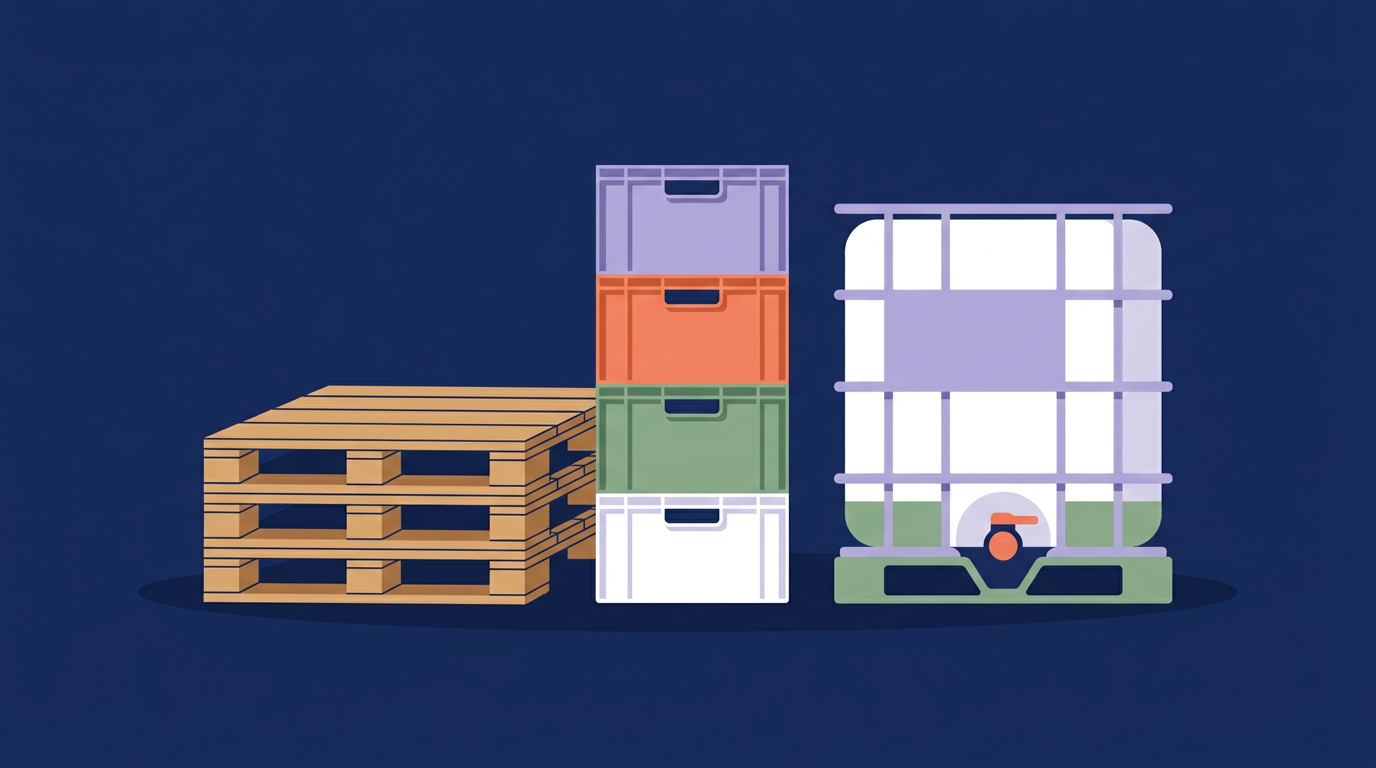
EPR programs were originally designed around household waste, packaging that consumers put in residential bins. B2B and industrial transport packaging, pallets, intermediate bulk containers, drums, totes, large outer cases, generally goes through a different waste stream, often handled commercially or under separate regulations.
That difference is reflected in EPR scope rules, but not uniformly. Some regimes pull substantial B2B packaging into scope; others exclude most of it. Most have nuanced treatment that depends on the specific format and end use.
The classification matters financially. B2B packaging is heavy on a per-unit basis. Misclassifying tonnes of it as in-scope household packaging produces inflated fees; misclassifying in-scope tonnes as out-of-scope produces under-reporting.
The general framework
Most EPR/PPWR regimes distinguish:
- Primary packaging. The unit packaging that contains the product as sold (the bottle, the can, the wrap). Almost always in scope.
- Secondary packaging. Grouped sales packaging that holds primary units (the multi-pack tray, the carton holding 12 cans). Generally in scope when it reaches consumer level.
- Tertiary / transport packaging. Packaging used to handle, transport, or store goods between businesses (pallets, shrink wrap, IBCs, drums, large outer cases). Treatment varies most.
Across regimes, the pattern is roughly:
- UK pEPR. Distinguishes household and non-household packaging. Non-household packaging is in scope but at different (typically lower) fee structures. The 2026 fee differential is set in the published pEPR rate sheet.
- EU PPWR. Covers all packaging in principle, with reuse and design rules differentiating B2B and consumer formats. EPR fees and reuse targets apply, but with sectoral exemptions and B2B-specific reuse mandates.
- US state EPR programs. Mostly focus on household-stream packaging. Pure B2B transport packaging is often out of scope, though the line varies. California SB 54, Oregon, Colorado, Maine, Maryland, Minnesota, and Washington each draw the boundary differently; consult each state's published rule for current treatment.
What is generally clear
Almost always in scope:
- Primary consumer packaging.
- Secondary retail-display packaging that reaches consumer level.
- Outer cartons used in DTC ecommerce delivery to consumers (these reach households).
Almost always out of scope (or differently scoped):
- Wood pallets used purely in upstream logistics.
- Large reusable IBCs returned to the supplier after use.
- Steel drums and bulk containers used in industrial chemical or food ingredient supply chains.
- Pallet shrink wrap used between distribution centers when separated and recycled at the DC, not at consumer level.
Where the line is unclear
Mixed-use packaging. A corrugated case might be a transport pack between DCs but become a retail display unit at the store. The case reaches consumer level in store visibility, but waste is typically handled at the retailer's commercial waste stream, not in households.
Bulk-to-consumer formats. Large food-service packs (institutional jars, restaurant-sized cans) sold to foodservice operators may end up in commercial waste streams, but if sold direct to consumers in club stores, they end up in households.
Ecommerce overpacking. A pallet of small consumer items shipped to a 3PL is B2B transport packaging until it is broken down and shipped as parcels to consumers. The breakdown point determines whether the secondary outer case reaches consumers.
Returnable systems. Packaging used in closed-loop systems (returnable totes between supplier and customer) is generally out of household-stream scope but may still be subject to PPWR reuse target accounting.
What this means by jurisdiction
For each EPR jurisdiction, producers need to know:
- Whether the regime distinguishes household and non-household packaging.
- The fee differential (or scope exclusion) for non-household.
- The boundary rules for mixed-use packaging.
- Reporting requirements for B2B-only packaging (some regimes require reporting even if the fee is zero).
A producer with significant B2B sales should not assume B2B is "out of scope" globally. The right answer is jurisdiction-by-jurisdiction.
Common failures
Failure 1, Treating all transport packaging as exempt. A producer files only consumer packaging. Audit reveals the regime in question treats outer cases delivered to retail as in-scope packaging, with substantial under-reporting.
Failure 2, Treating all packaging as in-scope. A producer files all packaging tonnage including pure B2B transport, paying fees that the regime did not actually require. Recovery is possible but operationally expensive.
Failure 3, Channel mismatch. A SKU sold through both retail and B2B channels has its packaging filed once, with the wrong scope assumption. The correct treatment is split by channel volume.
Failure 4, Missing the reporting obligation for non-household. Some regimes require reporting non-household packaging tonnage even if no fee is due. Skipping the report because the fee is zero produces a registration violation.
What to do in 2026
- For each regime where you have packaging in scope, define your treatment of B2B transport packaging explicitly. Document the rule.
- Map your packaging inventory by household/non-household based on where the packaging actually reaches its end-of-use.
- Split mixed-use SKUs by channel volume rather than picking one classification.
- Confirm reporting requirements for non-household tonnage even where no fee applies.
How Packgine helps
Packgine carries the household/non-household attribute at the channel level, applies jurisdiction-specific scope rules, and produces split filings that reflect channel-mix accurately. B2B-only volume is reported where required and excluded where appropriately exempt, without a manual carve-out per filing.
Related reading
Ready to automate your packaging compliance?
See how Packgine manages EPR, PPWR, and sustainability reporting from a single dashboard.
Related articles
Scope & Edge Cases · European Union
Chemical Recycling and Mass Balance Accounting Under EPR and PPWR
Scope & Edge Cases
Compostable Packaging: EPR Fee Classification
Scope & Edge Cases · United Kingdom, European Union
Marketplace Producer EPR: Amazon, Walmart, eBay
Scope & Edge Cases · United Kingdom, European Union
Small Producer Thresholds: UK, EU, and US EPR
Scope & Edge Cases
Ecommerce Shipping Packaging: When It's In Scope
Scope & Edge Cases · European Union
Food Contact Packaging Exemptions: EPR and PPWR