The Two Grams Nobody Reported: Packaging Change Control for EPR
By Kevin Kai Wong, Managing Partner at gCurv Technologies
Published: August 18, 2026 | Updated: August 18, 2026

Ask a packaging team how a spec change reaches the compliance record and you rarely get a process back. You get a name. Some engineer in the middle of the building who hears about the change, remembers it, and types it in before reporting season. On about half the calls I run, that one person is the entire control. She also takes vacation.
The mistake sitting underneath is treating the record as bookkeeping that happens after the decision. It is not. The record is part of the decision, and under California SB 54 the gap between those two ideas has a price with two sides.
Almost everyone assumes the price is a fee you overpay. That is the smaller half.
The bigger half is the reduction you actually delivered and cannot claim. California anchors every source reduction calculation permanently to calendar year 2023 under PRC section 42057(b), and the anchor never moves. There is no relief for growing. Against a fixed anchor, every gram you take out is worth claiming, and you can only claim what the record can evidence with a date attached. That stopped being a theoretical point this year. The Office of Administrative Law approved the permanent SB 54 regulations on May 1, 2026, effective on filing. Registration closed on June 1. The 2023 baseline producer report fell due on July 1, and individual source reduction plans followed on August 1. The numbers in your record are now the numbers in your filing. If you are still mapping those obligations, our California SB 54 implementation guide walks the full sequence.
So where does the number actually break?
A compliance analyst at a mid size beverage company found hers in the worst way: as a rounding error that refused to round. She was building the annual filing, the report that tells the regulator how much packaging the company placed on the market. Two numbers should have matched. The plastic tonnage implied by her specification records, and the tonnage implied by what procurement had actually bought. They sat about 220 kilograms apart per million bottles.
One bottle. Two weights. Her records said 24 grams. Every supplier invoice since spring said 22.
Change control is the discipline that stops this. In plain terms: no change to a pack, its weight, its material, its recycled content, takes effect until somebody records it against the compliance record with a date on it. This company approved its change properly. Nobody told the record.
How does a good change go unrecorded?
Maya, the senior packaging engineer who signed the approval, pieced the story together in an afternoon. She is a composite of three teams I have worked with, and the only reason I can compose her is that this failure repeats with the same shape every time.
| Date | Event | System that changed |
|---|---|---|
| March 4 | Supplier proposes lightweighting the bottle preform from 24 g to 22 g | Supplier development file |
| March 18 | Line trial passes | Engineering trial log |
| March 27 | Approval signed, procurement updates the purchase order | Purchasing system |
| May 12 | First production at 22 g ships | Supplier records |
| Never | Compliance record updated | None |
| Following February | Reconciliation finds the gap | The filing draft |

Every step there is defensible. The supplier proposed a good change. Engineering tested it. Procurement repriced it. The one system that feeds fee calculations and annual reports sat outside the loop, because nobody inside the loop needed it to finish their own job.
What does one wrong number cost?
Start with the credit, because it stings most. Those two grams were real, achieved reduction. Unrecorded, so unclaimable. SB 54 measures you against 2023 on two metrics at once, total plastic weight in pounds and total plastic component count, with each discrete piece counted separately, and both have to be met independently. January 1, 2027 wants 10 percent off each, plus at least 2 percent of plastic weight moved into reuse or refill.
Then the fees. Most EPR programs charge by weight, so a record that overstates weight overstates the fee input on every unit sold. Small error, large multiplier.
Third, the assessments. The recyclability score for that bottle referenced the 24 gram spec. Maybe the change moved the score, maybe it did not. You only get to ask the question once you know the change happened.
Which metric does your change actually move?
This is where reduction programs quietly go wrong, and it is worth twenty minutes of your next planning session. Lightweighting moves one metric. Only one. Two grams off a preform lowers your pound count and leaves the component count exactly where it was, because the bottle is still one bottle. Pulling a closure liner, collapsing a two piece cap into one piece, deleting a shrink band: those move count.
Most reduction pipelines I see are almost entirely weight pipelines. They arrive at 2027 having hit one target and missed the other, on a law that grades both separately. Sort your open change log by which metric each change moves. If every line moves weight, you have a plan for half the requirement.
Why can you not just correct the number later?
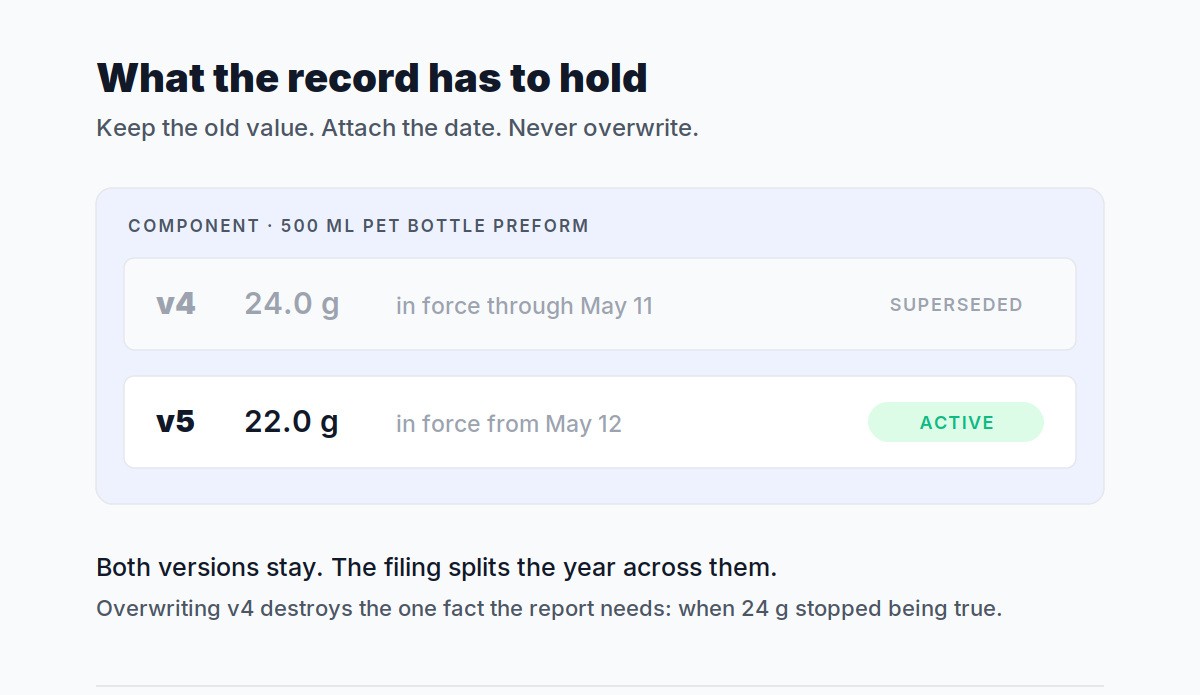
Because the filing does not ask what the bottle weighs today. It asks what the company placed on the market during the reporting year, and that year contained both bottles: four and a half months at 24 grams, seven and a half at 22. A record holding one value with no date cannot describe that year truthfully. Even a well meant correction fails if it overwrites the old number, because the overwrite destroys the one fact the filing needs, which is when the old value stopped being true.
There is a second reason, and it lands in the plan rather than the report. The PRO has been explicit that producers cannot change calculation methods between years to flatter their reported reductions. You document your method once and hold it. Holding it is only possible if the underlying values keep their dates. Effective dates on spec changes are one of the fields teams most often overwrite in place, which is why they show up in our packaging data model field list. Without them, consistent methodology is a sentence in a plan with nothing behind it.
So what did Maya actually build?
No committee. One rule: the record takes part in the approval.
A change request now gets logged against the component record itself, stating the attribute, the old value, the new value and a proposed effective date. An email thread does not count. Before approval, four questions run. Does the change move weight, material, resin or recycled content? Does it touch a live assessment or an on pack claim? Does it move fee exposure anywhere the company sells? Does it touch a reporting baseline? Any yes brings compliance into the room before the decision instead of after it. Four noes clear in minutes, which is the part that keeps engineers from routing around the whole thing.
Approval requires a real effective date. When current stock runs out is not a date. Period. The approved change becomes a new version of the record, timestamped, with the previous version kept intact. Then somebody confirms the change actually propagated, so fee calculations read the new number from the right day forward.
Packgine's Packaging Specification Hub carries these mechanics. Every spec change is versioned, timestamped and attributed, and supersede workflows keep downstream systems pointed at the active spec. The BOM hierarchy links primary, secondary, tertiary and transport components, so one changed preform traces up to every finished good it ships in and down to the supplier and plant that produce it. Supplier sync lets the supplier submit the new weight against the record instead of into somebody's inbox. Getting that data out of the source systems is its own exercise, covered in our ERP integration patterns. Maya's team kept every approval decision they had always kept. What they stopped doing was relying on memory to carry that decision into the record.
What goes through the gate, and what does not?
The gate only stays fast if the trigger list is honest. Weight, material, resin, structure, recycled content, closures, and anything a live claim references go through it. A graphics refresh on the same substrate with the same inks does not.
One gap stays open, and let me be straight about it. Change control catches announced changes. A supplier who quietly substitutes material is a different failure, and you catch that one with periodic verification, spot checks against what actually arrives, not with a workflow the supplier never entered. Run both. Each covers what the other cannot see. Where the PRO sits in all of this is worth reading separately: see what a PRO actually does.
Did the reconciliation clear?
A year later the same analyst ran the same reconciliation and the gap was gone, which was the least interesting line in it. Version 4 of the record carries 24 grams through May 11. Version 5 carries 22 grams from May 12, tied to the signed approval, with the supplier's confirmation attached. The filing splits the year correctly across both. And the reduction the company genuinely delivered now sits in the record as evidence, dated and attributable, against a 2023 anchor that will never move again.
Send us one component. We will walk its version history from change request to filed report, and you will find out whether your own record can still tell you what that component weighed last April. Book a working session, or check your obligation status first with the EPR checker.
Ready to automate your packaging compliance?
See how Packgine manages EPR, PPWR, and sustainability reporting from a single dashboard.
Sources
- CalRecycle, Packaging Extended Producer Responsibility System (PEPRS): https://www2.calrecycle.ca.gov/Packaging-EPR/
- Mayer Brown, California's SB 54 EPR Regulations Take Effect: Key Deadlines and Compliance Obligations for Producers, June 2026: https://www.mayerbrown.com/en/insights/publications/2026/06/californias-sb-54-epr-regulations-take-effect-key-deadlines-and-compliance-obligations-for-producers
- California Public Resources Code section 42057(b)
About the author
Kevin Kai Wong, Managing Partner at gCurv Technologies. He works with consumer brands and importers on packaging compliance data, covering US state EPR reporting and EU PPWR conformity evidence.