State Compliance10 min read

    California SB 54: May 31 Producer Reporting Deadline

    The Annual Supply Report and Source Reduction Report using CY 2025 data are both due May 31, 2026. This is the first reporting cycle that feeds directly into fee calculations. Here is what producers must file and how to prepare.

    By Kevin Kai Wong, Managing Partner at gCurv Technologies

    April 13, 202610 min read
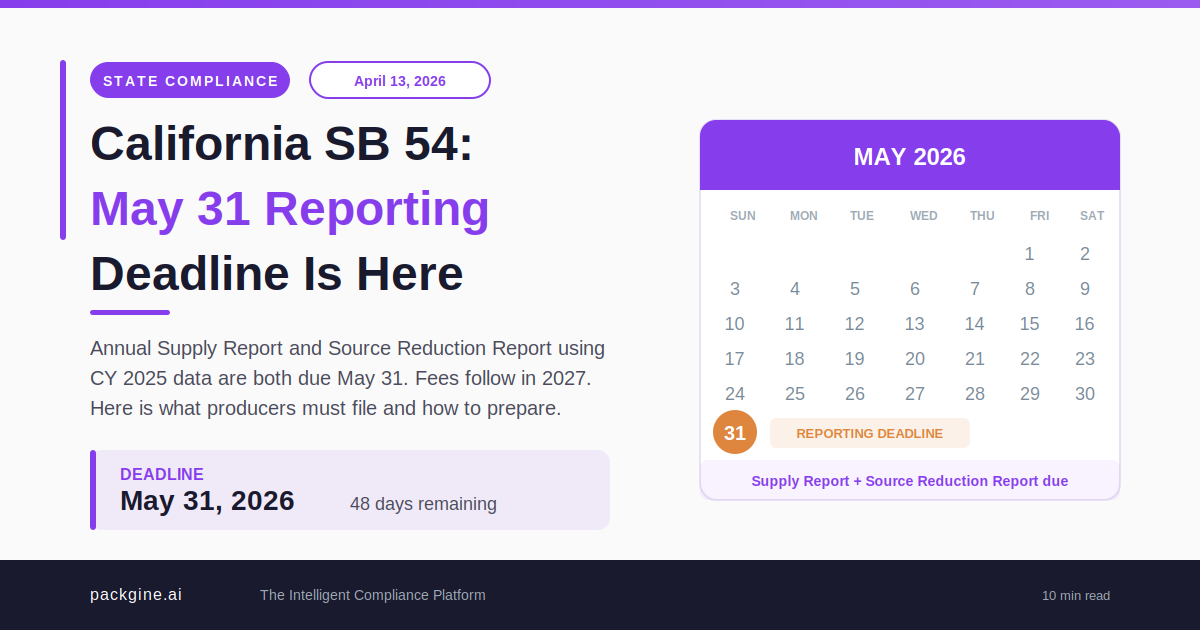
    California SB 54: May 31 Producer Reporting Deadline

    Table of Contents

    1. 1.Why May 31, 2026 Is the Defining Deadline for SB 54
    2. 2.What Reports Are Due on May 31
    3. 3.The 2023 Baseline Confirmation: A Parallel Deadline
    4. 4.June 15, 2026: CAA Submits the Program Plan
    5. 5.The ISR Plan: Due by August 1, 2026
    6. 6.Fees: What Happens After May 31
    7. 7.Regulatory Status: Where the Rules Stand Right Now
    8. 8.Five Steps to Prepare for May 31
    9. 9.How Packgine Handles the May 31 Reporting Workflow
    10. 10.Looking Ahead: The Rest of 2026
    Share:

    California SB 54: The May 31, 2026 Producer Reporting Deadline and What You Must File

    By Kevin Kai Wong, Managing Partner at gCurv Technologies

    California's SB 54 has moved from rulemaking uncertainty into operational reality. The most immediate action item for every covered producer is May 31, 2026: the date by which both the Annual Supply Report and the Annual Source Reduction Report must be filed with the Circular Action Alliance (CAA), using calendar year 2025 packaging data. This is the first reporting cycle where the data directly feeds into fee calculations. What you file on May 31 determines what you pay starting in 2027.

    This guide covers exactly what is due, how the May 31 deadline connects to the regulatory milestones that follow, and what producers should be doing right now to prepare. If you need broader context on SB 54's structure, fee tiers, and long-term mandates, our California SB 54 EPR Compliance Guide covers the full program. This post focuses on the operational work required in the next 48 days.

    Why May 31, 2026 Is the Defining Deadline for SB 54

    Previous SB 54 reporting milestones carried less operational weight. The November 15, 2025 data submission used 2023 data and was set by CAA, not by statute. CalRecycle treated it as voluntary. That data supported program planning and baseline development, not fee assessment.

    May 31 is different. The 2025 data reported on this date is the first dataset that will be used to calculate producer fees. Fees become payable in 2027, and the fee amount is tied directly to the weight, material type, and recyclability profile of the packaging you report. Underreporting creates audit exposure. Overreporting inflates your fee obligation. Accuracy matters in a way it did not before.

    CAA has also harmonized the May 31 deadline across six EPR states: California, Oregon, Colorado, Maryland, Minnesota, and Washington. For producers operating in multiple states, this creates a single reporting window but also a concentrated data preparation burden. Every state has its own reporting categories and material classifications, and California's are among the most granular.

    What Reports Are Due on May 31

    Two separate reports must be submitted to CAA by May 31, 2026.

    Annual Producer Supply Report

    The Supply Report requires producers to disclose the total weight of every covered material sold or distributed in California during calendar year 2025, broken down by Covered Material Category (CMC). Each CMC entry must include the material type and packaging format, the recyclability classification under CalRecycle's CMC list (updated December 2024), and the recycled content percentage for any plastic packaging components.

    This report is the foundation for fee calculation. CalRecycle's eco-modulation framework adjusts fees based on how recyclable a material is within California's actual collection and processing infrastructure, how much recycled content it contains, and whether the format creates contamination risk in the recycling stream. Packaging classified as "easily recyclable" will pay significantly less per tonne than packaging classified as "difficult to recycle" or "non-recyclable."

    Annual Source Reduction Report

    The Source Reduction Report tracks actual plastic reduction activity during 2025, measured against the 2023 baseline that CalRecycle established. This report requires verified plastic weight and component counts supplied into California during 2025, a calculation of net source reduction achieved relative to the 2023 baseline, and the actual reductions assigned to recognized source reduction pathways.

    The recognized pathways include lightweighting (reducing material weight per unit), right-sizing (eliminating excess packaging volume), material substitution (switching from plastic to non-plastic alternatives), format elimination (removing unnecessary packaging components), and reuse or refill system adoption.

    This is a backward-looking, data-driven report. It measures what you actually achieved in 2025, not what you plan to achieve in the future. The forward-looking strategy document, the Individualized Source Reduction Plan, is a separate submission due later.

    One timing detail that matters: the first Annual Source Reduction Report is due before the ISR Plan. Producers will need to report what they have already accomplished before they have formally committed to a reduction strategy. For brands that have already been optimizing packaging, this is straightforward. For those that have not started, the May 31 report will show zero or minimal reduction, which then shapes the expectations for the ISR Plan.

    SB 54 Producer Compliance Calendar showing five milestones from April to August 2026, with May 31 reporting deadline highlighted as the primary deadline
    SB 54 Producer Compliance Calendar showing five milestones from April to August 2026, with May 31 reporting deadline highlighted as the primary deadline

    The 2023 Baseline Confirmation: A Parallel Deadline

    Alongside the May 31 reports, producers should prepare for a second submission: the final 2023 baseline data confirmation, due within 30 days of when the SB 54 regulations become effective.

    On March 19, 2026, CalRecycle submitted the latest draft regulations to the Office of Administrative Law (OAL) for approval, requesting an early effective date. OAL has thirty working days to act, which places the decision window at or before May 1, 2026. If OAL approves promptly and the regulations take effect shortly after, the 30-day baseline submission window could close around June 1, 2026, or possibly earlier.

    This creates a situation where two submission deadlines land within days of each other. The May 31 Supply and Source Reduction Reports cover 2025 data. The baseline confirmation covers 2023 data. Both flow through the CAA portal, but they serve different purposes. The 2023 baseline anchors the source reduction trajectory. The 2025 data shows initial progress against that trajectory and determines fee exposure.

    Producers who reported 2023 data during the November 2025 voluntary reporting window have a head start. Those who did not should prioritize compiling 2023 packaging data immediately, as the regulatory clock is expected to start within weeks.

    June 15, 2026: CAA Submits the Program Plan

    Two weeks after the May 31 producer reporting deadline, CAA is expected to submit its program plan to CalRecycle. This is a milestone for the program as a whole, not an individual producer obligation, but it matters for every covered producer because the program plan sets the framework for how fees will be collected, how recycling infrastructure investments will be directed, and how enforcement will operate once the program formally launches on January 1, 2027.

    After CAA submits the plan, the SB 54 Advisory Board will review it and provide written comments. A public comment period will open, giving producers and other stakeholders an opportunity to weigh in before CalRecycle issues final approval.

    The program plan will reflect the data that producers submitted through May 31. That means the accuracy and completeness of your reports directly influences the plan's assumptions about total packaging volume, material mix, recyclability rates, and reduction trajectories. Inaccurate or incomplete producer data creates a program plan built on unreliable inputs, which ultimately affects fee schedules and program targets for all participants.

    The ISR Plan: Due by August 1, 2026

    After the May 31 reports and the baseline confirmation, the next major producer obligation is the Individualized Source Reduction (ISR) Plan, due no later than August 1, 2026.

    The ISR Plan is fundamentally different from the annual reports. Where the Supply Report and Source Reduction Report look backward at what happened in 2025, the ISR Plan looks forward. It requires each producer to describe their intended strategy for meeting SB 54 source reduction targets: 10% reduction by 2027, interim targets by 2030, and the full 25% reduction by 2032.

    The plan must include projected plastic weight and component counts for future years, the allocation of reductions across recognized pathways (lightweighting, right-sizing, substitution, elimination, reuse), the rationale for pathway selection and timing, and any historical reductions achieved before the baseline period, supported by documentation.

    CAA will review each ISR Plan individually. Once accepted, the plan becomes a binding commitment between the producer and CAA. This is not a soft target or a statement of intent. It is an enforceable agreement that shapes compliance expectations for the next six years.

    The practical implication: start drafting the ISR Plan alongside the May 31 reports. The data you compile for the Source Reduction Report feeds directly into the forward projections required for the ISR Plan. Treating these as sequential tasks wastes time. Treating them as parallel workstreams creates efficiency.

    Fees: What Happens After May 31

    The May 31 reporting deadline connects directly to fee obligations in three phases.

    **Early fees arrive in August 2026.** CAA will issue early-fee invoices based on the data reported by May 31. These pre-program fees fund California's pre-launch activities, including infrastructure assessments, program administration setup, and the plan review process.

    **Program launch fees begin in January 2027.** When the SB 54 program formally launches on January 1, 2027, full annual fees become payable. The fee schedule will reflect eco-modulation adjustments based on each producer's material mix, recyclability profile, and recycled content levels.

    **The ongoing fee structure continues from 2027 onward.** CAA expects to collect approximately $500 million annually from producers. These funds support recycling infrastructure expansion, environmental mitigation in communities disproportionately affected by plastic pollution, consumer education, and program operations. Fee obligations continue annually, with each year's data submission on May 31 feeding the following year's fee calculation.

    The connection between reporting accuracy and fee exposure cannot be overstated. Packaging classified as "easily recyclable" in California may pay $100 to $250 per tonne. Packaging classified as "difficult to recycle" may pay $500 to $1,500 per tonne. Non-recyclable materials face fees of $1,000 to $3,000 per tonne. A single classification error across a high-volume SKU can create a six-figure fee discrepancy.

    Regulatory Status: Where the Rules Stand Right Now

    The rulemaking process for SB 54 has moved through several iterations. Governor Newsom directed CalRecycle to restart regulations in March 2025, after the initial rulemaking attempt drew criticism over proposed exemptions for food and agricultural packaging. CalRecycle withdrew the proposed regulations in January 2026 for targeted revisions focused on food and agricultural commodity packaging, then resubmitted a revised package to OAL on March 19, 2026.

    OAL has until approximately May 1, 2026 to approve or disapprove the submitted regulations. If approved, the regulations take effect once filed with the Secretary of State. If OAL disapproves, CalRecycle would need to revise and resubmit, introducing additional delay.

    For producers, the practical approach is to prepare as if the regulations will take effect on schedule. The statutory obligations under SB 54 exist regardless of the regulatory timeline. CalRecycle has enforcement authority under the statute, and CAA has established its own operational deadlines to keep the program on track for a January 2027 launch. Waiting for final regulatory text before beginning data preparation is a strategy that creates compressed timelines and unnecessary compliance risk.

    Five Steps to Prepare for May 31

    May 31 readiness checklist showing five items every producer must complete for SB 54 compliance
    May 31 readiness checklist showing five items every producer must complete for SB 54 compliance

    1. Verify CAA Registration and Participant Producer Agreement

    You cannot file reports without a signed Participant Producer Agreement (PPA). Late registration does not eliminate the obligation. If you have not registered, do it now. The compliance clock started running when you first sold covered products in California.

    2. Compile CY 2025 Packaging Data by Covered Material Category

    Pull together the total weight of every covered material sold in California during 2025, broken down by CMC. This requires current packaging specifications with verified material weights, recyclability classifications aligned to CalRecycle's December 2024 CMC list, and recycled content documentation for plastic components. If your packaging data lives across ERP systems, supplier declarations, and spreadsheets, consolidating it into a single queryable format is the critical first step.

    3. Quantify Source Reduction Activity Against the 2023 Baseline

    Compare your 2025 plastic weight and component counts against the 2023 baseline. Document which recognized pathways generated reductions: lightweighting, right-sizing, material substitution, format elimination, or reuse/refill. If you have not tracked packaging changes at this level of detail, reconstruct the record from procurement data, specification revisions, and supplier communications.

    4. Reconcile Recyclability Classifications to California Infrastructure

    CalRecycle uses SB 343 criteria to evaluate recyclability, and the CMC list published in December 2024 includes updated recyclability and compostability determinations. A material that is recyclable in your home state or in Europe may not meet California's standard. Review every packaging format against the California-specific CMC list, not against general recyclability assumptions.

    5. Begin Drafting the ISR Plan

    The ISR Plan is not due until August 1, but the data required for it overlaps heavily with the May 31 submissions. Start building the forward projections now, while the 2025 actuals and 2023 baseline comparisons are fresh. Identify which pathways offer the most realistic reduction potential for your portfolio, and model the cost and timeline for each.

    How Packgine Handles the May 31 Reporting Workflow

    Packgine automates the data collection, classification, and report generation required for the May 31 deadline within a platform that covers all six active US EPR states and the EU PPWR.

    For California specifically, Packgine pulls packaging data from your existing systems and maps it to CalRecycle's Covered Material Categories automatically. The platform applies California-specific recyclability classifications using the December 2024 CMC list, calculates source reduction metrics against the 2023 baseline by recognized pathway, generates CAA-formatted Supply Reports and Source Reduction Reports ready for portal submission, and models projected fees under the current eco-modulation framework so you can see your estimated 2027 exposure before you file.

    For producers managing compliance across California, Oregon, Colorado, Maryland, Minnesota, and Washington simultaneously, Packgine's harmonized May 31 reporting workflow eliminates the need to maintain separate data preparation processes for each state. The underlying packaging data is structured once, and jurisdiction-specific reports are generated from it.

    Explore our capabilities or book a demo to see how Packgine handles the May 31 reporting workflow for your portfolio.

    Looking Ahead: The Rest of 2026

    May 31 is the most immediate deadline, but it is not the last. The rest of 2026 brings a concentrated sequence of compliance milestones.

    The 2023 baseline confirmation is due within 30 days of the regulations becoming effective, likely around June 1. CAA submits its program plan to CalRecycle around June 15. The SB 54 Advisory Board reviews the plan and opens public comment. The ISR Plan is due by August 1. Early fee invoices arrive in August. And the program formally launches January 1, 2027, when full fees and enforcement become operational.

    Each milestone builds on the one before it. The May 31 data feeds the program plan. The program plan shapes the fee schedule. The ISR Plan locks in your reduction commitments. The August invoices give you your first actual cost number. Treating these as isolated tasks creates gaps. Treating them as a connected workflow keeps the team ahead of each deadline.

    For a broader view of how SB 54 fits within the multi-state EPR landscape and the EU PPWR, see our 2026 EPR and PPWR compliance overview. For questions about your specific compliance position, reach out to our team.

    Content reviewed by Kevin Kai Wong, Managing Partner at gCurv Technologies.

    Ready to automate your packaging compliance?

    See how Packgine manages EPR, PPWR, and sustainability reporting from a single dashboard.

    Other Related Content

    California SB54: EPR Compliance Guide 2026

    March 28, 2026

    California SB54: EPR Compliance Guide 2026

    Packaging EPR & PPWR 2026: What CPG Teams Know

    April 9, 2026

    Packaging EPR & PPWR 2026: What CPG Teams Know

    U.S. Packaging EPR 2026: Guide for CPG Brands

    March 28, 2026

    U.S. Packaging EPR 2026: Guide for CPG Brands