Know Exactly What's Missing
The compliance dashboard, completeness check, reporting pipeline, and regulatory tracking, all built around one idea: data you can trust.

Compliance data is only useful if you can trust it — trust that it's complete, trust that what's on screen reflects reality, trust that what you file matches what you computed. This release is about all three.
See your whole compliance picture in one place
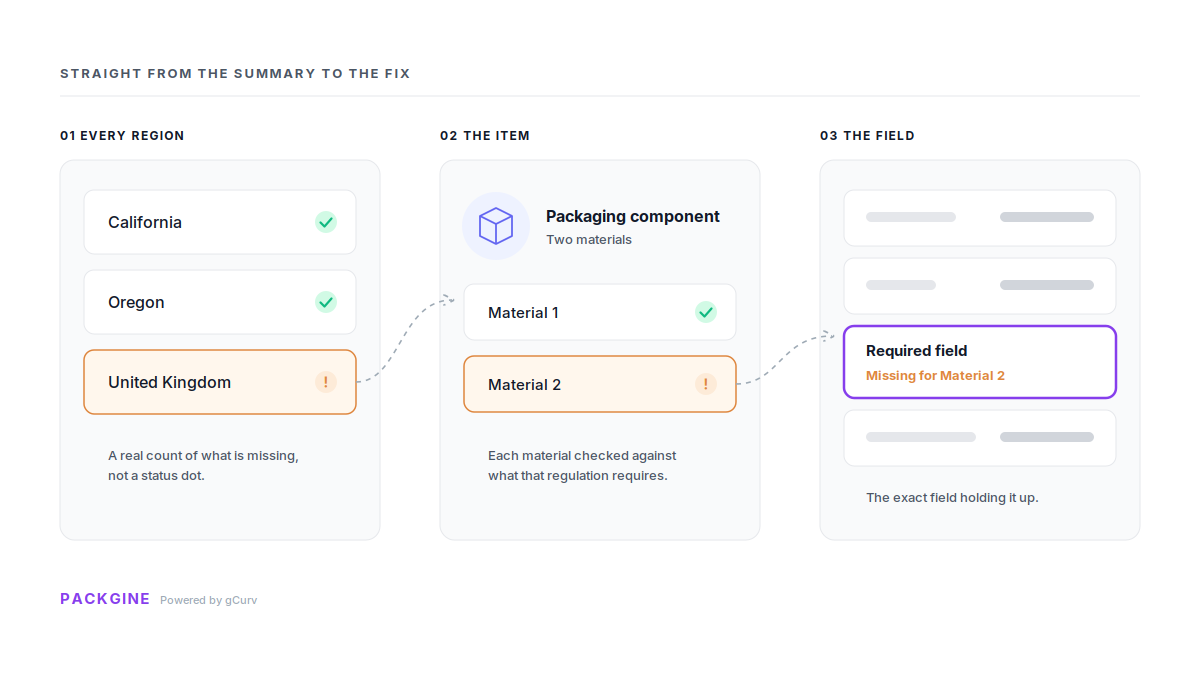
Most teams juggling multiple regions end up checking each one separately — a screen for California, a spreadsheet for Oregon, a different tab for the UK. The global compliance dashboard puts all of it in one place: every bundle, every region, a real count of what's missing instead of a status dot, and a direct path from that count to the exact item and field holding it up.
Straight from the summary to the fix.
Completeness, down to every material
A packaging component is rarely one material. Our completeness scoring evaluates every material on an item against what that specific regulation actually requires for it — the real, material-specific requirements each region sets, not a generic checklist.
One material
Two materials
Why it matters
Whatever your packaging is made of, you see exactly what each material needs before you file.
One report, start to finish
A report is one continuous record — from the first run through the final export — so what you file always matches what you computed. Run California, Oregon, and the UK together, not one at a time.
Staying current, so you don't have to
New states pass EPR laws. Existing ones update fee schedules and taxonomies. We track these changes as they happen, so your compliance data — and the fees and filings built on it — stay current with what's actually in effect, not what was true when you last checked. This cycle brought new state programs online and refreshed fee and taxonomy data across the ones you already use.
See it, trust it, file it — and never be the one tracking what changed. That's on us.
The full technical changelog lives separately — this is the short version, for what actually changes your week.
What's next
More of these, on a regular cadence — that's the point of starting. If something in your day-to-day feels harder than it should, tell us. A fair share of this cycle started as exactly that kind of note.
Pravin M.
Published 28 September 2026
Sources and further reading
- CalRecycle: SB 54 Plastic Pollution Prevention and Packaging Producer Responsibility Act Permanent Regulations: https://calrecycle.ca.gov/Laws/Rulemaking/SB54Regulations/
- Oregon Department of Environmental Quality: Implementation of Oregon's Recycling Modernization Act: https://www.oregon.gov/deq/recycling/pages/modimplementation.aspx
- GOV.UK: Extended producer responsibility for packaging: who is affected and what to do: https://www.gov.uk/guidance/extended-producer-responsibility-for-packaging-who-is-affected-and-what-to-do
Related reading
Ready to automate your packaging compliance?
See how Packgine manages EPR, PPWR, and sustainability reporting from a single dashboard.