
The First 24 Hours of an Inventory Hold
The regulatory bulletin landed in quality's inbox at 10:42 on a Tuesday. By 11:15, supply chain had placed holds on affected stock in three warehouses.
The change was a labeling rule in one of the company's largest markets, and it made the claim printed on the pack noncompliant. The stock was four months of printed bottles and cartons, bought long for unit cost. By end of day, four functions held four instincts. Sales wanted to keep shipping. Legal wanted everything quarantined. Finance wanted the write off number. Marketing wanted new artwork by Friday.
The common mistake: act on one of those instincts before anyone has read the clause. Five moves instead, in order. Classify what changed. Verify the transition provisions without assuming any. Size the affected stock precisely. Compare the options each lot is eligible for. Then decide once, across functions, on paper. Luis, the supply chain director, ran the sequence.
What kind of rule change actually strands packaging inventory?
Rule changes strand inventory in three different ways, and misdiagnosis is the first expensive mistake.
A lawfulness change means the packaging itself, a material, a substance or a format, can no longer be placed on the market. Continued sale then depends entirely on whatever transition provisions the rule grants, and on nothing else. A claim or label accuracy change, which is this case, leaves the pack sellable but makes an element on it noncompliant, so correction options may exist. A fee or reporting change strands nothing physically. It belongs in the fee forecast, not a disposition process.
Misclassify in either direction and it costs. Quarantining sellable stock over a fee change burns value for nothing. Shipping a lawfulness case on an assumed grace period builds exposure no later cleanup repairs.
Can you rely on a sell through period or grace window after a packaging rule changes?
Only if you can point to the clause. Teams remember sell through periods and exemptions existing from the last event, and that memory is where the damage starts. Verify every provision against the rule itself: the exact clause, its dates, its conditions, and what counts as placed on the market under that rule. Confirm with the authority or counsel. Document it in the disposition file.
The distinctions are worth warehouses. Provisions can turn on whether packaging was manufactured, imported or placed on the market before the effective date, and those are three different piles of stock. California's SB 343 shows how precise this gets. CalRecycle states the restrictions apply to products and packaging manufactured after October 4, 2026, regardless of when they are sold. Manufacture date, not sale date. The same page notes a federal court paused enforcement in July 2026. Paused enforcement is not a repealed rule.
The EU drew its line elsewhere. Recital 14 of the Packaging and Packaging Waste Regulation says packaging already placed on the Union market before the relevant requirements apply should not need to meet the new sustainability and labelling requirements. A different trigger, a different pile.
Where a clause reads two ways, the ambiguity goes to counsel, not to the commercially convenient reading. A disposition built on an assumed sell through is an enforcement finding with inventory attached.
What do you need to know before deciding what to do with the stock?
Which components the rule touches. Which products and lots carry them. Which markets each lot can lawfully reach. Where the stock physically sits, and what stage it is at.
Component to finished good traceability does the heavy lifting here, because rules attach to component attributes while inventory decisions attach to finished products. With the bill of materials in Packgine's Packaging Specification Hub, tracing the affected label element to every finished product it ships in produced a same day affected list.
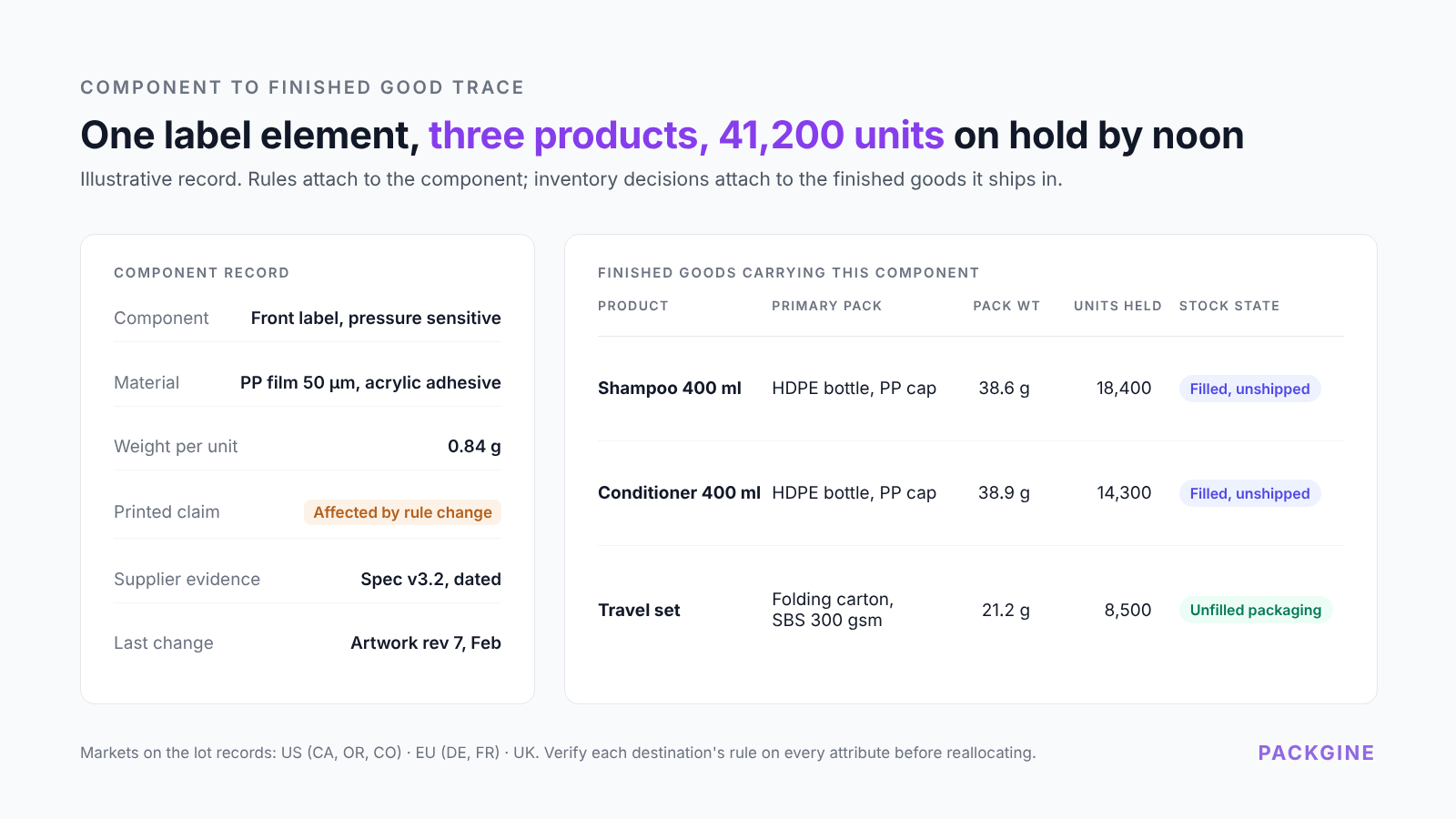
Without a maintained record, that list is a manual hunt measured in weeks. Label claims are the attributes most likely to move. When SB 343 was signed, its author, California State Senator Ben Allen, put it plainly: Consumers are being misled by the placement of the recycling symbol on items that aren't actually recyclable
(press release, 25 October 2021). Every claim on your pack is now a regulated attribute. Know where each one lives.
Which disposition options is each lot of packaging eligible for?
Eligibility branches on stock state, and every branch stays conditional on the verified provisions.
Unfilled packaging gets the cheapest menu: over sticker after a feasibility trial, reallocate to markets whose rules verify clean, or recycle. Filled but unshipped stock can reallocate where destination rules check out on every relevant attribute, be reworked into compliant packaging, or be written off. Shipped stock already in trade is the hardest branch. Contractual control over trade inventory may not exist at all. Trade stock often follows a different rule than warehouse stock. Verification question first, logistics second.
Sell through, reallocate, over sticker, rework or recycle: which one wins?
Sell through works only inside a verified provision's dates and conditions, documented, and it is available less often than commercial teams hope. Reallocation works only after the destination markets' rules verify on every relevant attribute, not just the changed one, and only where the freight math survives. Moving inventory in order to lose less is still losing.
Over stickering works where the applicable rules permit the correction and it is feasible at volume.

Feasibility at ten thousand units and feasibility at ten million are different questions. Rework or repack is usually the most expensive corrective route, with quality and food safety implications where product is involved.

Recycle or destroy is the floor: recycling where the material stream allows, compliant disposal, the write off routed through finance. Destroying usable packaging has a real environmental cost, which argues for exhausting reallocation and correction first. It never argues for stretching a provision past what verification supports.
Who signs off on a packaging disposition decision?
One forum, not four instincts. Legal confirms the provisions and which options are permitted. Compliance confirms the affected scope. Finance owns the write off with its advisers. Brand weighs what stickers and variants look like to customers. Supply chain owns execution and the timeline. The output is one documented decision per lot group: option, basis, dates, owner. The file matters, because a stranding event is exactly what a later audit or dispute revisits.
How do you stop the next rule change from stranding packaging?
Three measures shrink the next event. Earlier warning: a maintained view of upcoming program deadlines feeding procurement's buy decisions. Packgine's Inventory Compliance Alerts supply this as pre deadline alerts at sixty, thirty and seven days, which turns a long buy on claim bearing artwork into a conscious risk instead of a default. Shorter commitments on at risk artwork, because regulation sensitive elements justify shorter print runs even at worse unit economics. And maintained traceability, because scoping takes hours with a live record and weeks without one.
What does a finished disposition record look like?
Per lot group, signed and dated. Trade stock in the affected market sells through under the verified provision, with the reference and counsel's memo attached, until its stated end date. Unfilled cartons route to over stickering after a feasibility trial on five thousand units. Filled bottles in the affected market's pipeline reallocate to two markets whose rules verified clean.

A residual lot of short dated stock is written off and recycled, treatment routed through finance. One number reached finance instead of four arguments. And the document that answers an auditor in two years already exists. Period.
Trace one component through Packgine's bill of materials and time how long the affected list takes. Not sure which markets' rules reach your packs? Check which packaging obligations apply first.